With the average engagement ring in Toronto now exceeding $7,500, walking into a jewellery store shouldn't feel like a high-stakes gamble. Most couples I meet at my downtown studio are understandably worried about being overcharged or confused by technical jargon. Knowing the right questions to ask your jeweller is the only way to cut through the noise and ensure you're making a sound choice. It's my belief that you deserve a transparent, education-first environment where your vision takes centre stage over a sales quota.
I've put together this masterclass checklist to help you secure master Canadian craftsmanship and an investment-grade diamond that will stand the test of time. You'll learn how to vet a maker's expertise, navigate the complexities of diamond grading, and avoid the common pitfalls of the 2026 GTA market. In my experience, the best results come from a collaborative process where you feel like an informed partner rather than just a customer. This guide provides the framework you need for a stress-free design experience that results in a piece as enduring as your commitment.
• Understand why vetting an independent studio is the first step to avoiding high-pressure retail chains and commission-based sales.
• Master the technical questions to ask your jeweller regarding diamond origin and the necessity of reviewing GIA or IGI grading reports.
• Differentiate between genuine bespoke creation and mass-produced assembly by asking for 3D CAD renderings or physical wax models.
• Ensure the longevity of your investment-grade purchase by establishing clear expectations for resizing and long-term maintenance from the outset.
In my experience, the first of the essential questions to ask your jeweller should be about their direct involvement in the creation process. Many people don't realize that a significant portion of mall-based retailers are simply reselling mass-produced mounts or outsourcing their work to large factories. By asking, "Are you an independently owned studio or part of a larger retail chain?", you immediately determine if you are speaking to the person who will actually handle your stone or a salesperson working on commission.
This distinction is vital for quality; many long-standing family businesses, such as BOS Jewelers Inc, have built their reputation over four decades on this exact principle of direct, expert involvement and personal service.
Heritage matters when you're making an investment-grade purchase. A third-generation jeweller brings a depth of knowledge regarding diamond quality characteristics that a seasonal employee simply won't possess. It's the difference between reading a spec sheet and understanding how a specific cut will perform under the unique lighting of the GTA. When you sit down in a private downtown Toronto studio, you should feel a sense of shared vision rather than the pressure of a ticking clock in a crowded retail centre.
Ask about their personal role: "Will I be working directly with you from the first sketch to the final polish?" In my experience, clients find that a one-on-one consultation offers far more value than a high-pressure environment. I’ll help you select a stone that fits your budget while ensuring the structural integrity of the piece. You want a partner who listens to your story, not a clerk who pushes whatever inventory is currently on the floor.
Reviewing a custom diamond engagement rings gallery Toronto is the best way to gauge a studio's versatility and attention to detail. Don't be afraid to ask: "Do you specialize in specific cuts, such as oval or emerald cut diamonds?" These shapes require a precise eye for symmetry and a specific setting style that not every bench jeweller has mastered. Seeing past work confirms they can translate your abstract ideas into a tangible, lasting piece of art.
If you're ready to start your journey with a transparent, expert guide, I invite you to book a free private consultation at my downtown Toronto studio where we can discuss your vision in detail.
When preparing your questions to ask your jeweller, start with the source of the stones to ensure they are conflict-free. While Canada strictly adheres to the Kimberley Process, you should still ask, "Can I review the original GIA or IGI grading report for this specific stone before I commit?" A certificate provides the baseline, but in my experience, a report is just the starting point. You must also ask the jeweller to explain the "eye-cleanliness" of the diamond. Two diamonds with the same clarity grade can look vastly different if one has a central black inclusion while the other hides its flaws near the girdle.
Expertise involves looking beyond the paper. I suggest reviewing these questions to ask about diamond quality to understand how cut and fluorescence impact the stone's fire. I’ll help you select a stone that fits your budget by identifying where you can compromise without losing visual impact. This educational approach ensures you're making an informed, investment-grade decision.
Ethical sourcing is non-negotiable. Ask: "Are your stones conflict-free and traceable?" Whether you choose natural stones or lab-grown diamonds, the provenance matters. Natural diamonds often hold higher resale value, while lab-grown options allow for a larger stone for the same investment. I find that Toronto couples are increasingly prioritizing this transparency to ensure their ring aligns with their values.
A ring must survive the reality of daily life. Ask: "Will this hidden halo or pavé band hold up to daily wear in a busy city like Toronto?" Delicate designs are beautiful, but they require master Canadian craftsmanship to ensure longevity. I often recommend 14k gold or platinum for active clients because 18k gold is softer and more prone to scratching. Prong thickness is another detail; too thin, and you risk losing the stone; too thick, and you hide its beauty. If you're unsure which metal suits your lifestyle, we can discuss your options during a private session.

In my experience, the word "custom" is often misused in the jewellery industry. Many retail stores claim to offer bespoke services but actually just assemble pre-made components from a catalogue. To ensure your piece is truly unique, one of the most vital questions to ask your jeweller is whether they create a 3D CAD rendering or a wax model specifically for your stone. I’ll help you select a stone that fits your budget and then build the architecture of the ring around that diamond's exact millimetre dimensions. This ensures a flush fit and superior structural integrity that mass-produced rings simply cannot match.
While the visual design is exciting, you must also consider the long-term protection of your piece. I recommend incorporating questions about jewelry care and warranties during your initial meeting. Understanding how the ring is built helps you realize why certain settings require more maintenance than others. A truly bespoke journey is a collaborative effort between your vision and my technical expertise.
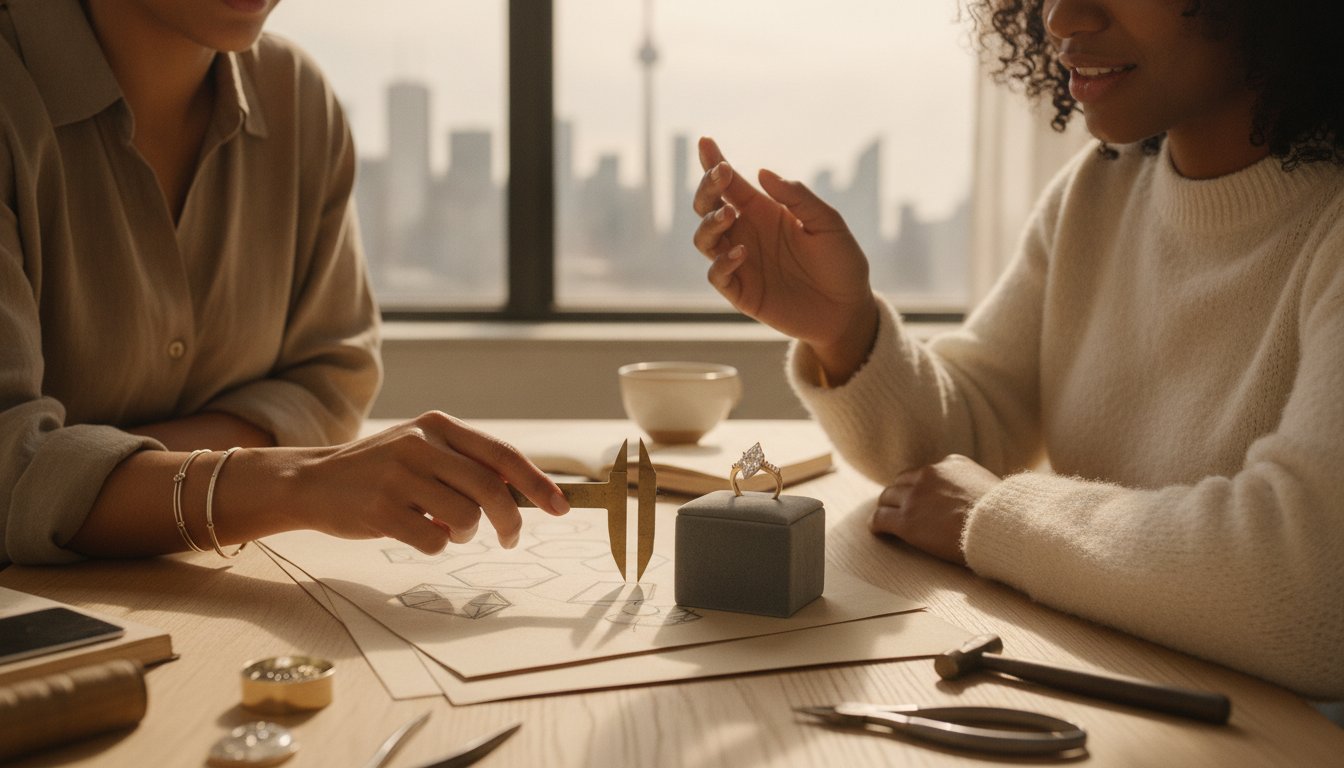
You should never be left guessing what the final product will look like. My process involves a clear progression: an initial sketch, a digital CAD rendering, and often a physical wax model for you to inspect. You can see exactly what to expect at a Livia Diamonds consultation to help normalize the experience. This multi-stage approval ensures that the master Canadian craftsmanship meets your standards before we ever cast the metal.
Quality cannot be rushed. Ask: "How many weeks do you need from the final design approval to the proposal-ready ring?" In the current 2026 Toronto market, master Canadian craftsmanship typically requires 4 to 6 weeks. This timeline allows for precision casting, hand-setting each stone, and a final rigorous quality check. If you have a specific proposal date in mind, it is best to schedule your design session at least two months in advance to ensure every detail is perfect.
Buying an engagement ring is an investment-grade purchase that requires a long-term perspective. It isn't just about the day you propose; it's about the decades of wear that follow. When narrowing down your final questions to ask your jeweller, you should focus on who will stand behind the work years down the road. In my experience, the relationship with your jeweller truly begins the moment you walk out of the studio with your finished piece.
One of the most practical queries involves fit. Ask: "What is your policy on resizing, and is the first resize included in the price?" Toronto’s climate can cause fingers to swell in the humid summers and shrink in the cold winters, making a precise fit essential. Beyond sizing, you must inquire about maintenance schedules. I recommend a professional cleaning and prong check every six months to keep the sparkle alive and ensure the stones remain secure. This proactive care prevents the heartbreak of a loose diamond.
Maintaining your overall aesthetic for a proposal or wedding is just as important; many individuals rely on professional lash services using LivBay Lash Supplies to ensure every detail of their look is perfect for the occasion.
Delicate designs require ongoing attention. Ask: "If a small pavé stone falls out, how do you handle the replacement?" Choosing an independent jeweller like Aret Oymakas provides a level of accountability that big-box stores cannot replicate. When you work with me, you're ensured that any future repairs are handled with the same master Canadian craftsmanship used to build the ring originally. I take personal pride in every piece that leaves my bench, ensuring it remains in heirloom condition.
Your tastes or budget may evolve over time. Ask: "If we want to celebrate a 10th anniversary with a larger stone, can we trade in the original diamond?" Understanding this policy early adds significant long-term value to your initial purchase. I’ll help you select a stone that fits your budget today while keeping the door open for future milestones. This flexibility is a hallmark of a jeweller who views you as a lifelong partner rather than a one-time transaction.
If you have more questions or want to see the quality of my work firsthand, I invite you to book a free private consultation at my downtown Toronto studio to discuss your vision.
Navigating the 2026 Toronto market requires more than just a passing knowledge of the 4Cs. By mastering these questions to ask your jeweller, you've moved from being a casual shopper to an informed partner in the design process. You now understand the vital difference between mass-market retail assembly and genuine bespoke creation. This ensures your investment-grade diamond is protected by master Canadian craftsmanship that will endure for generations. In my experience, the most meaningful rings are always built on a foundation of transparency and shared vision.
I’ll help you select a stone that fits your budget while ensuring every structural detail is handled with third-generation expertise. My collaborative, one-on-one design process is specifically crafted to remove the anxiety and pressure often felt in traditional retail environments. I invite you to book a free private consultation at our downtown Toronto studio to discuss your vision in a relaxed, professional setting. Your journey toward a truly personalized engagement ring should be just as memorable as the proposal itself.
Custom design often provides better value because you aren't paying for a retailer's overhead or dead inventory. When considering the questions to ask your jeweller, ask how they optimize costs through direct sourcing. I’ll help you select a stone that fits your budget, allowing us to allocate funds toward the diamond rather than a generic markup. You control the cost by choosing specific diamond quality characteristics, making it an investment-grade purchase tailored to your financial goals.
Every rough diamond imported into Canada must be accompanied by a valid Kimberley Process Certificate to prevent the trade of conflict stones. When you prepare your questions to ask your jeweller, always request documentation that proves the stone's ethical provenance. For absolute certainty, look for CanadaMark diamonds, which are subject to strict environmental and labour regulations. This provides a transparent trail from the mine to your finger.
Yes, you can certainly repurpose a family stone into a modern piece featuring master Canadian craftsmanship. Before we begin, I conduct a thorough inspection to ensure the diamond is free of structural damage like chips or internal fractures. This allows us to honour your family heritage while building a new setting that provides the durability required for daily wear in the city. It is a wonderful way to create something new while preserving sentimental value.
Platinum and 14k gold are the most resilient choices for those with an active GTA lifestyle. While 18k gold is more prestigious, it is also softer and more prone to wear over time. Platinum is exceptionally dense and holds stones with incredible security; however, 14k gold offers a harder surface that resists scratching better than its higher-karat counterparts. I often recommend 14k gold for those who work with their hands frequently.
I recommend a professional inspection and cleaning every six months to maintain the integrity of your piece. During these visits, I check the prongs and the structural architecture of the setting to prevent stone loss. Regular maintenance ensures your ring remains as brilliant as the day you first proposed, protecting your investment for the long term. This quick check-up is the best way to catch minor wear before it becomes a major repair.

© Copyright 2023 Livia Diamonds. All Rights Reserved